
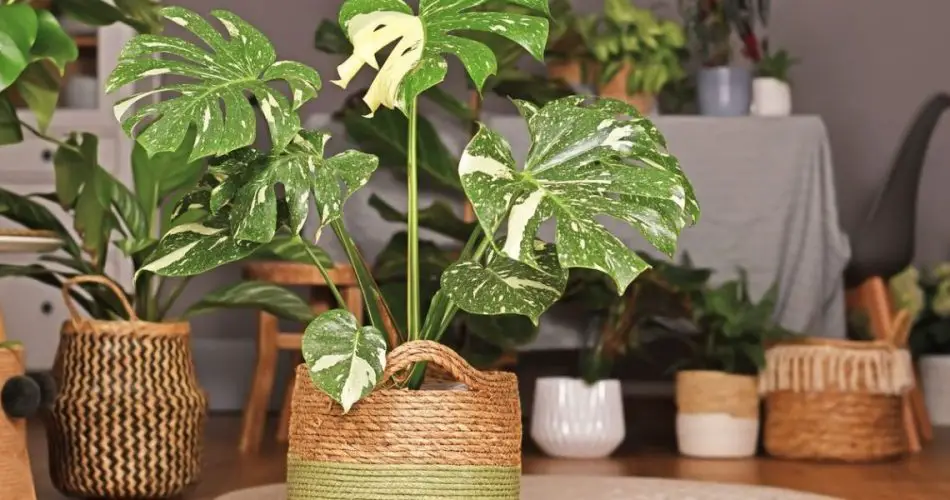
The ideal conditions to grow your Monstera
Like all plants, Monstera deliciosa needs certain conditions to grow and thrive.
First of all, the location of your plant is paramount. It is advisable to place it near a light source, such as a window, without exposing it to direct sunlight.
The Monstera also appreciates a certain level of humidity, which can be obtained by placing a container filled with water nearby or by regularly spraying water on its leaves.
Finally, make sure to maintain a fairly stable room temperature, around 20°C, with variations of only a few degrees between day and night.
The right dose of water for a Monstera in top shape
Watering is a key part of caring for your Gruyere plant.
In fact, too much or too little water can quickly affect the growth and health of your Monstera. It is recommended to water the plant once or twice a week in summer and once every two weeks in winter.
To make sure you don’t overwater, wait until the soil is almost dry at the surface before adding water. Adding liquid green plant food once a month helps provide the nutrients your Monstera needs to grow.
If there is too much water, Monstera leaves can show brown, soft spots, while a lack of water manifests as dry, brittle leaves.
To avoid these problems, don’t hesitate to adapt the frequency of watering according to the season and weather conditions, keeping in mind that your plant needs slightly moist but well-drained soil.
Trim and Maintain Monstera Leaves for a Glowing Plant
Pruning and maintaining the leaves are essential to maintaining the aesthetic appeal of your Monstera deliciosa and promoting its growth.
In fact, the removal of yellowish, dry or damaged leaves allows the plant’s energy to be redirected towards new shoots and still healthy leaves. To do this, use clean, sanitized pruning shears and cut the leaves at the base of their petiole, near the main trunk.
It is also important to periodically clean the leaves of your Monstera, to remove dust and possible remains of insects or diseases.
To do this, use a damp and soft cloth and gently wipe it on each side of the leaves, avoiding getting them too wet. This simple gesture preserves the health of your plant and lets its leaves breathe, while enhancing its decorative appearance.
Repotting, a key step in the care of your Monstera
Repotting your Gruyère<! era plant is a crucial step in ensuring its growth and development.
In fact, over time, Monstera’s root system grows and needs more space to expand.
In addition, transplanting renews the soil and provides the plant with the necessary nutrients. In general, it is advisable to repot your Monstera every two to three years, in spring or early summer, when the plant is in full growth period.
To repot your Monstera, get a pot that is slightly larger than the previous one, with drainage holes at the bottom. Prepare a mix of potting soil for houseplants and compost, which you will place in the bottom of the new pot.
Gently detangle the roots of the plant and place it in the pot, covering the roots with the potting mix and compost. Be careful not to bury the trunk of the plant, which should remain visible and slightly above ground level.
Finally, water thoroughly so that the soil adheres well to the roots and lightly tamp down the soil around the plant.
Finding the right support to help your Monstera climb
Monstera deliciosa is a climbing plant that, in its natural habitat, clings to tree trunks and other supports to elevate itself.
Therefore, to promote its development and growth indoors, it is important to provide it with adequate support in which it can lean and hold onto. Several options are available to you:
- A bamboo or wooden stake, which you will plant in the pot near the main trunk and to which you will attach the stems of the Monstera by means of flexible links.
- A metal or plastic trellis, which you will attach to the wall behind your plant and over which you will guide the stems so that they adhere to it.
- A foam mast, specially designed for climbing plants, which provides a rough and moist surface for the aerial roots of the Monstera to grip and hydrate.
Whichever stand you choose, make sure it’s strong enough to support the weight of the plant and large enough to allow your Monstera to continue to grow and develop.
By following these maintenance tips and tricks, your Monstera deliciosa will be in perfect condition and you will be able to give your interior a unique touch of greenery and exoticism.
Do not hesitate to adapt these recommendations to your environment and the specific needs of your plant, and to carefully observe the reactions of your Monstera to give it the best possible care.
Pampered in this way, your Gruyère plant will enchant you with its magnificent openwork leaves and majestic presence.