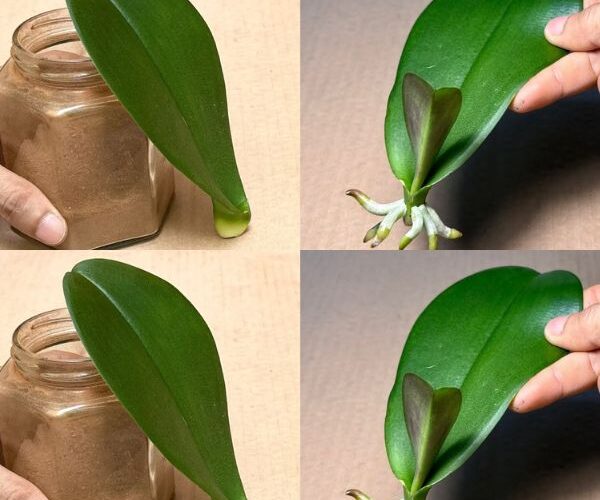

Cross and Plant Lover’s Delight: The orchid is a wonderful plant, but it certainly can’t be said to be easy to grow!
Being quite delicate, it doesn’t take much to upset your balance, compromising your health and, in the most severe cases, leading to your death.
Among the many existing species and varieties, undoubtedly the most common is the phalaenopsis orchid, which adapts very well to our domestic environments. The name derives from the shape of the flowers, resembling large colored moths.
But what to do if our beautiful Phalaenopsis orchid shows silvery gray roots? Let’s see together what it depends on and how to solve this problem.
NB: in case of doubts or uncertainties, ask for the help of a professional who will be able to help you in the best way to save your orchid.
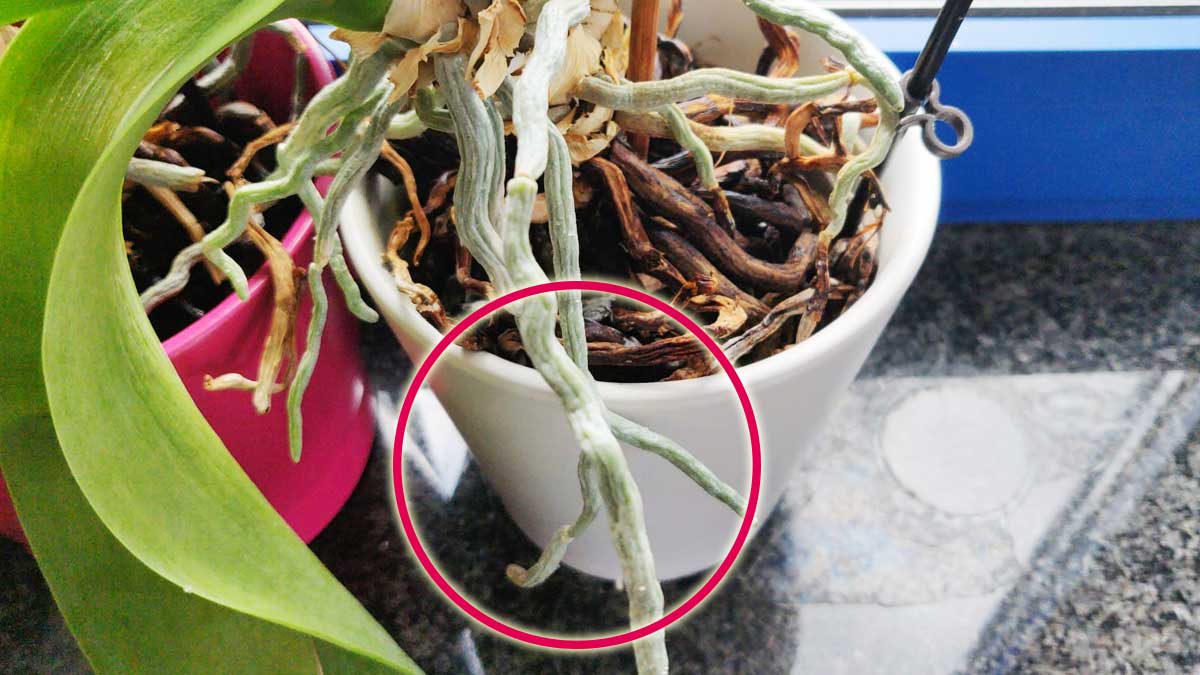
How to notice
You can notice this problem in the roots by observing them closely.
For aerial roots, no problem, as they are not buried.
For underground roots , however, you’ll need to extract the orchid from the ground for testing. In reality, however, we often grow orchids in transparent plastic pots (in fact, sunlight must also reach the roots for greater well-being of this plant). As a result, we can observe the state of the underground roots even without removing the plant from the pot.
NB: If the roots have a greenish-gray color, it is a normal situation . Only be alarmed if the color tends towards silver.
Causes
The problem of roots is a problem that has very specific causes. Let’s look at them together.
Water scarcity
The main cause of silvery-gray roots (both underground and aerial) is a lack of water.
Maybe you’ve watered the plant too little or neglected it for a few days that were too hot.
In fact, when we don’t water our orchids enough , their roots tend to discolor, assuming a classic silvery-gray color.
Not surprisingly, the same roots also tend to look dry and harder to the touch.
Low humidity
Another cause of silvery-gray roots is low environmental humidity.
This happens when we place the orchid in a place where the air tends to be dry and there is not much air exchange.
This is a fairly common cause if we live in small and poorly ventilated apartments.
Solutions
Now let’s see what the solutions are to water scarcity and low humidity. Remember that, when the problem arises, it is necessary to intervene as soon as possible.
More watering
To solve the problem, one of the solutions is to water the plant more.
It is best to water it by immersion, that is, by submerging the pot of your orchid in a sink or container filled with at least 15 cm of water and wait about 30 minutes.
During this time, the plant will absorb all the water it needs.
Then, let it drain and put it back in place.
Change location
The other solution, to adopt when the cause is a low humidity index, is to change the location of your orchid.
Ideally, it should be placed in a fairly humid place, such as the bathroom.
If you do not have a sufficiently humid room, you can always spray a little water on the leaves of the orchid every 2-3 days, using a handy steamer .
In this way, the humidity level will remain optimal and, with it, the state of health of the roots.
Root cutting
If the roots, in addition to being silvery gray, are also very dry, there is a risk that they will die and can infect the rest of the plant.
In this case, you can cut them with well-disinfected scissors.
If it’s aerial roots, you don’t have to pull the plant out of the ground. However, in the case of underground roots, you must first pull the plant out of the soil and clean the roots from the soil.
Note: Before cutting the roots, it would be advisable to wet them to make them softer. To do this, you can immerse the plant in a container filled with water for about 30 minutes before proceeding with cutting.
After trimming the dried roots, disinfect the cut site with some ground cinnamon, which is a natural antibacterial and antifungal.
Then, replant the plant (if you pulled it out of the ground), being careful not to damage the remaining roots.
Dry or rotting roots?
Sometimes, due to inexperience, we tend to confuse dry roots due to lack of water with rotten roots due to excess water.
The former take on the classic silver-grey colour, harden and wrinkle.
Roots rotten by too much water, on the other hand, tend to take on a much darker brownish-black color. Plus, they feel soft to the touch.