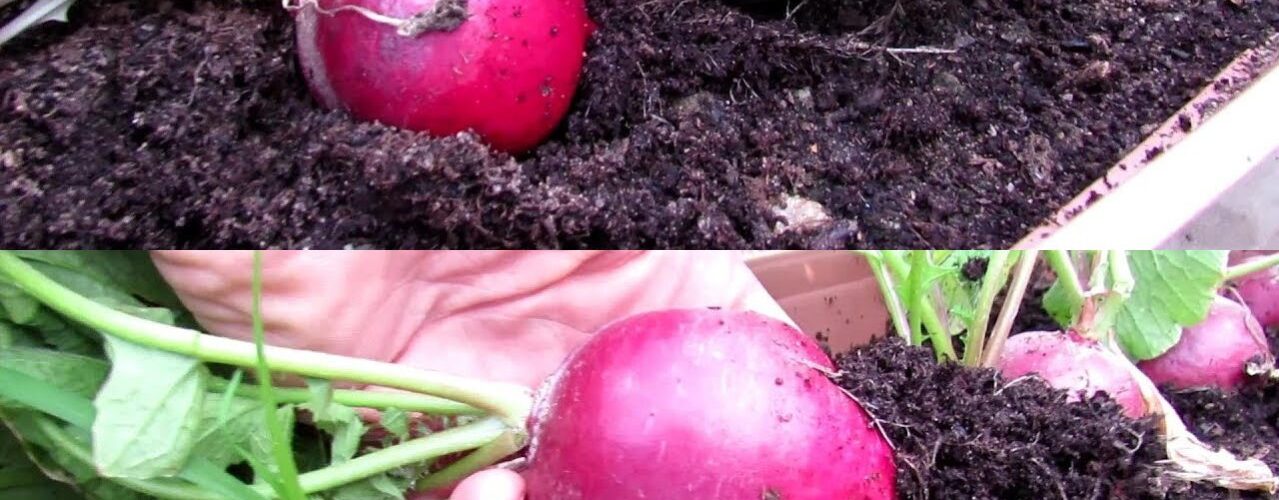

1. Understand what a radish is and its benefits
Radish (Raphanus sativus) is a tuber of the Brassicaceae family, native to Asia.
Prized for its spicy, slightly peppery flavor as well as its crunchy texture, radishes are usually eaten raw in salads or roasted, but can also be cooked or added to soups and stir-fries.
Rich in vitamins (especially vitamin C) and minerals (such as potassium and calcium), radishes have several health benefits . They are involved in good digestion, have diuretic and detoxifying properties and can help prevent certain cardiovascular diseases. In addition, their low calorie content makes them a food of choice for people concerned about their weight.
2. Choose the variety of radish adapted to your needs and your climate
There are many varieties of radishes , each with specific characteristics in terms of size, color, flavor and planting time.
Here are some examples:
- 18 Day Radish : Fast growing, this red radish is ideal for impatient gardeners who want to harvest quickly.
- Flamed radish : cylindrical in shape and bright red in colour, it is appreciated for its tender and slightly spicy flesh.
- Black radish : large and elongated, it is appreciated for its strong and slightly spicy flavour. It is best grown in autumn and winter.
- Daikon radish : Originally from Japan, this elongated white radish can reach up to 40 cm in length. It is used in particular to make sushi and kimchi.
To choose which radish variety to grow, consider your flavor preferences, the space available in your garden, and the climate in your area. Some varieties are better suited to cold climates, while others prefer sunny, warm exposure.
3. Prepare the soil and sowing
Radishes grow well in well-drained, fertile, slightly moist soil .
Before planting, prepare the soil by digging and removing stones and weeds. Then, incorporate well-rotted compost to enrich the soil with nutrients.
Radishes are usually sown in the ground , but it is also possible to grow them in pots or planters on a balcony. To do this, choose a container at least 20 cm deep and make sure it has drainage holes.
Radish is a fast-growing vegetable that can be sown all year round in temperate regions. In cooler regions, it is best sown between March and September for spring and summer varieties, and between August and November for autumn and winter varieties.
4. Planting and caring for radishes.
To sow radishes, proceed as follows:
- Make shallow furrows (about 1 cm) 15 to 20 cm apart.
- Sow the seeds, spacing them 2 to 3 cm apart, then cover lightly with soil.
- Water gently to avoid displacing the seeds.
Radish is a low-maintenance plant. However, it is important to follow a few basic rules to obtain a plentiful and tasty harvest:
- Water regularly and moderately to keep the soil moist, but not soaking wet. Too little water can cause slow growth and spiny radishes, while too much water can promote disease and rot. Preferably use rainwater or non-calcareous water.
- Make sure radishes get full sun or partial shade, depending on the variety being grown.
- Thin the plants by cutting them too close to each other, spacing them about 5cm apart to allow the radishes to develop properly.
- Regularly remove weeds that compete with radishes for soil resources.
5. Harvest and store radishes
Radishes are usually ready to harvest 3 to 4 weeks after planting , depending on the variety.
To know if a radish is ripe, look at the size of its top: it should be visible above the ground and have a diameter of about 2 cm for spring and summer varieties, and 4 to 5 cm for autumn and winter varieties.
To harvest radishes, gently pull the leaves to remove the vegetable from the soil, then wash with clean water to remove soil and root residue. Radishes can be eaten immediately or stored in the refrigerator for a few days, wrapped in a damp cloth or placed in a perforated plastic bag.
Radish leaves are also edible and can be used to make soups, omelets, pestos or green smoothies. Make sure to wash them thoroughly before consuming.
By following these tips and tricks, you should be able to grow tasty and crunchy radishes in your garden or on your balcony. Don’t hesitate to experiment with different varieties and combine radishes with other vegetables in your salads and cooked dishes. Enjoy your meal!