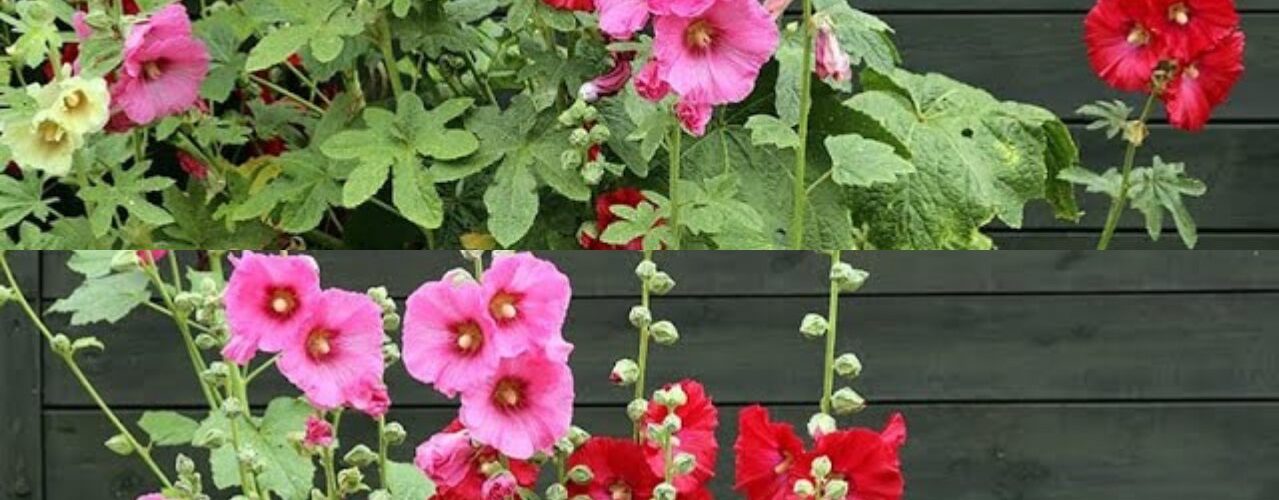

Origin and history of hollyhock
Hollyhock (Alcea rosea) is a perennial herbaceous plant in the Malvaceae family .
It is native to western Asia, particularly the eastern Mediterranean region. Hollyhock was introduced to Europe in the Middle Ages, where it quickly conquered the gardens and green spaces of monasteries thanks to its beauty and rapid growth.
Today, this plant is widely distributed throughout the world and is particularly appreciated for its majestic flowers that can reach up to 3 meters in height.
Botanical characteristics of the Hollyhock
Hollyhock is a perennial plant characterized by an erect and robust stem , which can reach 1.5 to 3 meters in height.
Hollyhock leaves are alternate, palmately lobed and toothed, with a hairy appearance . The solitary or clustered flowers are large and funnel-shaped, with rounded petals and various colors, ranging from white, pink, red, yellow, purple and even black.
The flowers typically bloom from June to September, providing a colorful and eye-catching spectacle.
Hollyhocks are pollinated by insects, especially bees and butterflies. Hollyhock fruits are circular capsules containing many seeds, which ensure the reproduction and dissemination of the plant.
Varieties of the Hollyhock
There are many varieties of Hollyhocks , differing in color, shape and size.
Some of the most popular varieties include:
- Alcea rosea ‘Nigra’ : This variety is highly appreciated for its deep black flowers, which add a touch of elegance and mystery to the garden.
- Alcea rosea ‘Chater’s Double Mix’ : This variety offers double flowers in a variety of colors, ranging from white, pink, red, yellow and purple, which bring a spectacular and lush effect to the garden.
- Alcea rosea ‘Halo’ – This series of hollyhocks is characterized by two-tone flowers, with a contrasting ring around the center of the flower.
- Alcea rosea ‘Apricot’ : As its name suggests, this variety offers flowers of a delicate and luminous apricot colour.
- Alcea rosea ‘Majorette Mix’ : This dwarf variety is ideal for small gardens or confined spaces, as it does not exceed one metre in height.
Cultivation and maintenance of the Hollyhock
Hollyhock is an easy plant to grow and does not require special care.
It prefers well-drained soils, rich in organic matter and a sunny or slightly shaded location. Hollyhock is also drought and wind tolerant, making it particularly suitable for coastal gardens or regions with a dry climate.
- Sowing: Hollyhock seeds can be sown in autumn or spring. It is recommended to sow them directly in the soil, because hollyhock does not like to be transplanted.
- Watering: Hollyhock requires regular watering, especially during dry periods. However, it is important not to overwater, as excess water can encourage the appearance of diseases.
- Staking: Due to the height of the stem, it may be necessary to stake the hollyhock to prevent it from falling over due to the wind or the weight of the flowers.
- Pruning: Pruning the Hollyhock consists of cutting the stem to about 30 cm from the ground after flowering. This pruning encourages the formation of new branches and prolongs the life of the plant.
- Diseases: Hollyhock can be susceptible to certain diseases, particularly rust and mildew. It is important to regularly monitor for symptoms and treat promptly if infection occurs.
Medicinal uses of hollyhock
In addition to its ornamental appearance, hollyhock has interesting medicinal properties , in particular thanks to its richness in mucilage, a substance with softening and emollient properties.
The flowers, leaves and roots of hollyhock can be used in phytotherapy to relieve various ailments:
- Respiratory disorders: Hollyhock is traditionally used to soothe coughs, sore throats and bronchitis, thanks to its emollient and expectorant action.
- Digestive problems: Hollyhock can help relieve abdominal pain, bloating and constipation, thanks to its emollient action on the digestive mucosa.
- Skin Conditions: Hollyhock’s soothing and anti-inflammatory properties are useful in treating irritations, minor burns, and skin inflammations.
It is important to note that the use of Hollyhock in herbal medicine should be done under the supervision of a health professional, as some people may have allergies or contraindications to this plant.
In short, hollyhock is a versatile plant, seductive for its majestic beauty and ease of cultivation.
It stands out as an essential plant in gardens and also offers interesting medicinal properties. Don’t hesitate to adopt it in your green space to take advantage of its many benefits.