
There is a real paradox between the perception we have of orchids, supposedly fragile plants, and reality: they are truly robust plants that bloom again in less experienced hands. These are the basics you need to know for maintaining indoor orchids.
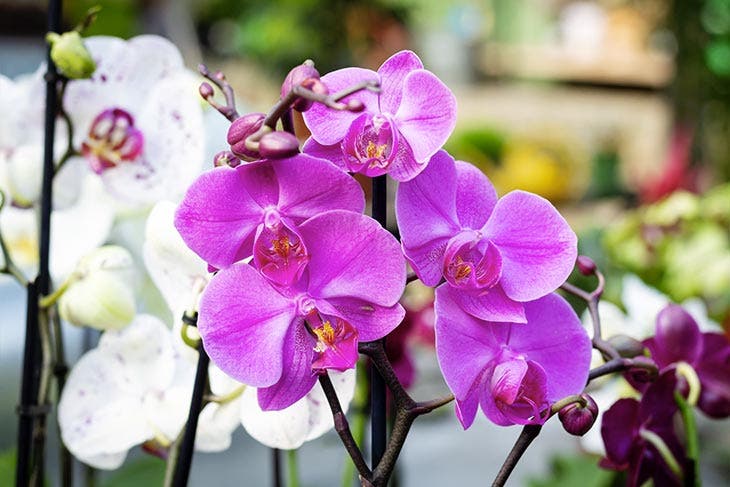
Orchid Robot Portrait
Each flower has five petals and a “lip” in the middle. This well-colored lip acts as a landing strip for insects that visit the interior of the flower. A good example of natural architecture!
The leaves are +/- fleshy, generally ovoid to oval, 10 to 40 cm long. Depending on the species, they can be hanging or almost horizontal. The color of the leaves varies from light green to dark green.
Inflorescences appear most often anyway in the axils of the lower leaf. They are generally branched and the flower stems, depending on the species, can vary from a few centimeters to 1 meter long. For some species, flowers open one after another, for others – almost simultaneously.
Phalaenopsis do not have pseudobulbs, but rather grow from a central rhizome (root) that produces one by one thick, fleshy leaves. An adult plant can carry 4 or 5 leaves at a time (sometimes more).
The roots are flattened, silvery and sinuous. They often break out of the pot, become aerial, and cling to anything they touch.
Growing conditions
Phalaenopsis grows wild on trees and rocks in the Asian and Australian rainforests.
Temperature: between 18 and 25° during the growth period. It is better not to expose the plant to a temperature below 20°.
At night the temperature should not fall below 16°, for young plants a few additional degrees are necessary. Phalaenopsis tolerate higher temperatures as long as they have good humidity.
Orchid: gentle fertilizer
Apply very light doses of fertilizer at the beginning of the season (March/April). Do not apply fertilizer in winter because the plant is dormant. Avoid stick fertilizers, because the fertilizer goes directly on the roots, which leads to the death of the latter or, at best, burns. Do not fertilize young plants and newly transplanted plants.
How to water an orchid?
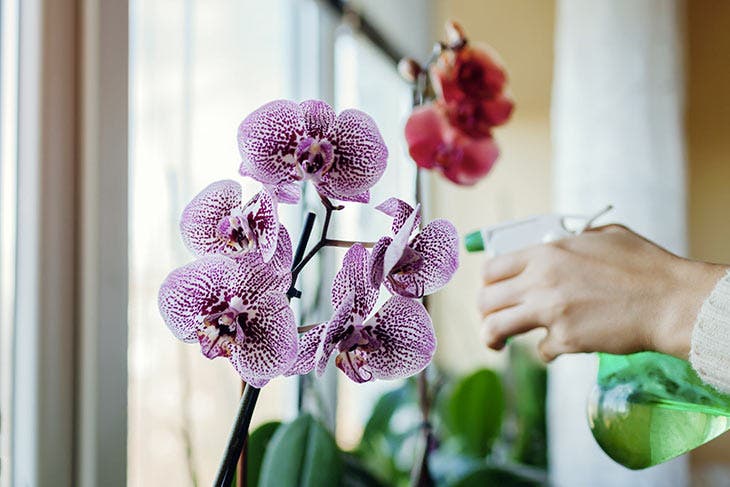
Watering should be done regularly but not excessively, at the risk of rotting the roots. If the roots (rhizomes) soften and turn black, watering will have to be spaced out and the pot drained well. In spring and especially summer, water twice a week, especially in hot weather. In winter, reduce watering to twice a month. Get used to weighing the pot. If the latter is light, water it. Preferably water the base of the plant in the morning with room temperature water. Avoid hard water because the orchid is very sensitive to it. The plant should never be soaked in water, except during occasional baths.
The correct location for an orchid
If this plant needs a lot of light, avoid direct sun. Avoid cold air currents. Never place it near flowers and cut fruits. Fruits such as tomatoes, bananas and apples produce high levels of ethylene. This gas will influence the production of ethylene in the plant and therefore cause faster aging of flowers and leaves. Phalaenopsis, sensitive to ethylene, could then present a drop of buds, flowers and/or leaves. Some orchids can spend the summer outdoors (Cymbidium), others cannot (Phalaenopsis).
Replant the orchid
Phalaenopsis can be transplanted all year round, but it is best to focus on the spring before the warm weather and the end of summer. Winter is not conducive to good vegetation recovery. Transplanting during this period should be avoided or reserved for plants in very poor condition to wait for spring. Do not transplant during flowering and in the presence of stems. To encourage flowering, or bud awakening, in Phalaenopsis, you can cut the faded flower stem above the second or third node (counting from the base). In other orchids, this stem will be cut 2 or 3 cm from the base.
Transplant technique
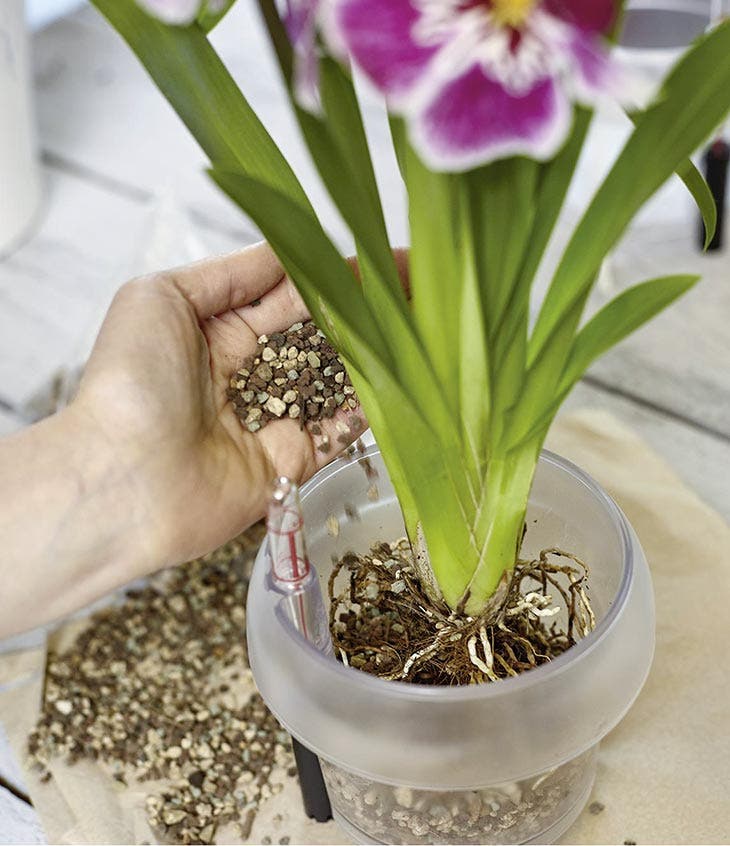
1- Carefully remove the plant from its original pot.
2- Remove all dead roots from their attachment points.
3- Aerial roots longer than 20 cm should be shortened. Remove old flower stems.
4- Fill half of the new pot with its substrate.
5- Position the plant in the center.
6- Fill the rest of the pot with the substrate, pressing very lightly.
7- Keep the plant in a humid and warm environment but without direct sunlight and moisten the substrate at the end of the transplant, then suspend watering for 3 to 4 days.
Choosing a pot and pot for an orchid.
Pot choice: take 1 pot with a larger diameter. For example: 12 cm, take 14 cm. Choosing the pot: The bottom can be flat if when watering you use the soaking technique or you can take a pot with a small lip at the bottom so that you can put the water up to the edge and the watering will be done. by capillarity. Preferably choose a transparent glass planter. You will be able to observe the quality of hydration of the roots and they will benefit from this to fill themselves with light. The roots should always be moist and green, otherwise the plant will dry out.
Orquídea: La Cosecha Keiki
The production of keikis is a mode of reproduction of epiphytic orchids. Keikis result from the development of adventitious buds in stems, leaves and roots generated by the spontaneous multiplication of vegetative cells. It is a kind of natural cloning. Keikis differentiate and develop on the stems or on the stems of old flowers.
The appearance of keikis is not always a good symptom: aging of the plant or the part that supports them, suffering linked to poor growing conditions. The appearance of keikis is related to the absence or inhibition of flowering (except for some Phalaenopsis species). Keikis are taken when their roots have reached a sufficient size (4-5 cm and have at least 3 leaves). They are then transplanted into a pot containing a substrate identical to that used for the adult plant, but with finer grain. Development is rapid and the plant can flower in a very short time.
How to combat mealybugs naturally?
Dilute in 1 liter of water: 1 teaspoon of black soap or liquid hand soap, 1 teaspoon of isopropyl alcohol; 1 teaspoon vegetable oil, simple salad oil.
Spray all leaves; then rub with a cloth so as not to burn the leaves; Put the plant in the shade. Repeat the operation several times if the mealybugs resist.
Precautions when buying a plant
After purchasing a phalaenopsis, place it away from others for a while (15 days on average). Then you will be sure that the plant is not sick. Indeed, with the change in growing conditions, the plant can develop diseases (appearance of parasites, mealybugs, etc. already present in the plant before purchase). To properly select a phalaenopsis, carefully look at its roots (almond green to deep green), the undersides of the leaves (fat, bright green leaves), and the condition of the flowers. Never buy orchids in the produce section, very bad location (gasoline)!
colors and aromas
There are various colors of orchids: from white to yellow, pink, purple, orange-red… But there is no blue Phalaenopsis, it is actually ink. The plant turns white again the next time it blooms. Colors come in solid, spotted, striped or dotted form.
The orchid family, which has about 25,000 species, offers a multitude of colors, but also delicious aromas. In addition to their beauty, the different varieties are distinguished by delicate, aromatic or more fruity fragrances. For example: Phalaenopsis cochlearis. It gives off a delicate smell of honeysuckle with a touch of lily of the valley; or the phalaenopsis Sweet Memory with a bergamot aroma and waxy petals dyed in a beautiful pink and fuchsia tone. Others are original orchids, such as the Eternal Wind “Summer Dream” brassia, a beautiful fragrant orchid with a honeyed aroma and starry flowers.
Did you know?
To protect themselves from desiccation, plants and trees lose their buds, flowers and leaves. In cut flowers and potted plants, this drop is often the result of an overproduction of ethylene, the only known natural gaseous plant growth hormone. Ethylene gas regulates the ripening and aging of cut flowers, potted plants, fruits and vegetables. Therefore, it is used to promote fruit ripening and flowering of potted plants.
The most common diseases of orchids.
1 – Typical damage from excess moisture: soft leaves, damaged roots. The plant has spent a lot of time in water.
2 – Rhizome rot, probably the most serious damage for a phalaenopsis. Caused by various types of rot, fungi and bacteria, a consequence of cultivation errors.
3 – Falling buds here there are also multiple causes, generally lack of light, cold or various cultivation errors.
4- Sunburn on the leaves, solution is to change the location of the orchid, without direct sun.
5 – Beginning of the bacterial attack on the leaf. Favored by too much humidity and lack of ventilation. Cut the damaged part.
6- Mealybugs. Treat quickly with an organic product.
7 – Attack of scale insects with a shield. Use a suitable product.
8 – Lack of water. Give him a bath.
9 – Dead orchid.
Symptoms
- Insufficient or stunted growth.
- Spots on the surface of the leaves first yellowish white and then brown.
- Spots on and under the leaves, irregular but well marked, yellowish in color, turning brown and dry.
- Leaf tips brown and dry.
- Flabby shoots, drooping buds.
Causes
- Wilted substrate, containing mold. Rotten roots. Location too dark. Insufficient fertilization.
- Plant exposed to the sun’s rays by an orchid that cannot stand it.
- Collapse of tissues under the effect of heat that attacks the root system. Prolonged exposure in an environment that is too dry.
- Air that is too dry, saturation of the substrate due to excess fertilizer or water that is too calcareous. Stagnant humidity.
- Insufficient light, cold at the roots, insufficient nutrition. Air laden with ethylene.
Solutions
- Remove the phalaenopsis. Clean the roots by cutting off the unhealthy ones. Pot with new substrate. Place in a well-lit place.
- Protect from direct sunlight.
- Choose a cooler, more humid, slightly shady location.
- Increase atmospheric humidity. Rinse the substrate under running water. Temporarily suspend the application of fertilizers.
- Avoid sudden cooling. Do not change the orientation of the orchid relative to the light source during bud formation.