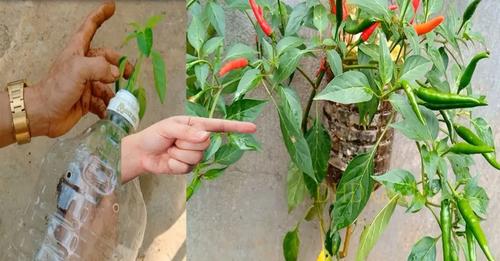
In the garden, some species blur the line between beautiful and delicious. Therefore, a question many home gardeners ask is: can ornamental peppers be eaten? Although typically grown for their brightly colored fruits, small ornamental peppers are actually edible. However, be careful! Its leaves are poisonous, like all plants in the nightshade family, such as tomato, eggplant and potato. Likewise, we should not confuse the edible ornamental pepper (Capsicum annuum) and the love apple (Solanum pseudocapsicum) whose fruits are poisonous! So, make sure it’s really a chili before trying it and stay away from the foliage.
Ornamental pepper: edible or not?
Although they are edible, keep in mind that most decorative peppers cannot boast too good taste qualities. In addition, some varieties are too spicy, or on the contrary: completely tasteless, so we really appreciate their flavor. Also remember that the leaves are dangerous not only to humans, but are also toxic to cats, dogs and other pets or domestic animals.
The edible ornamental pepper, whose beautiful fruits change color during the different stages of their maturation, is a plant that you will surely have in your backyard, on the balcony and even in the garden inside the house. All the yellow, orange, red and purple shades of mini peppers create a lot of good mood and immediately enchant the observer. But do you know how to care for decorative chilli pepper to enjoy its beauty for as long as possible?
General information
Several cultivars of Capsicum annuum can be described as edible ornamental peppers. They are generally perennials, but can be grown as annuals and their origins can be traced back to Central America. The height of the mature plant varies from 15 to 90 cm, it likes rich clay soil and full sun exposure. If you buy young plants from a nursery in the spring, keep in mind that you can transfer them to the garden once the soil has warmed to at least 21 degrees Celsius. Germination from seed to fruit production can take 12 to 22 weeks, depending on the specific variety.
Planting Tips
If you can grow cherry tomatoes, you can definitely grow ornamental peppers! They are both members of the Solanaceae family and love sun and warm weather. One of the most common mistakes when growing hot peppers is planting them outdoors too early. Young plants are available before the weather allows them to go into the ground, which can be deceiving. The trick to knowing if the moment is pleasant? If you think the weather is nice enough to swim in an outdoor pool, the conditions are also good for growing the ornamental edible pepper outdoors.
Not only should the risk of frost be far in the past, but the nights should also be quite warm, with air temperatures of 15 degrees C, preferably even higher. As already mentioned, the soil temperature should be at least 21 degrees C before sowing seeds outdoors or planting young plants there. Gardeners who grow decorative edible peppers from seeds often find it more convenient to plant seedlings indoors.
What orientation for my edible ornamental pepper?
When it comes to its exposure to sunlight, the edible ornamental pepper needs plenty of light to thrive. At least 6 hours of direct sunlight a day will provide it with the energy it needs to flower and produce colorful fruit. Therefore, if you are growing these plants indoors, you should use a horticultural lamp or some other type of supplemental artificial lighting to end up with healthy plants and good fruit set.
Outdoors, prefer a place protected from the wind so as not to stress the plant too much. In perfect harmony with their searing flavor, almost all peppers love heat. Therefore, sustained temperatures of 25 degrees C and above will encourage rapid growth. Initially planting hot peppers in cold soil can leave them stunted during the growing season.
Soil and pot cultivation
When talking about soil type, the ornamental edible pepper prefers rich, clay soil. Add manure or compost rich in trace elements that you can make yourself, even if you live in an apartment. If your soil is too clayey and heavy, plant your small ornamental peppers in raised beds or use containers to optimize drainage.
By the way, if you are growing your edible ornamental pepper in a container, any all-purpose potting mix will suffice, as long as the container has good drainage. The root system of the plant is small scale and is shallow. Therefore, a 15 cm deep container will be sufficient to receive your plant. However, do not forget that the soil in small containers dries out faster. It’s time to repot if you need to water the plants more than once a day.
Irrigation and application of fertilizers.
And what about water requirements? Although the edible ornamental pepper reacts poorly to dry conditions, it also does not like to be soaked in water. Therefore, water whenever the soil surface dries out and aim for a moisture level similar to that of a wrung out sponge: damp, but not soggy. Air humidity is a less important growth factor, as long as the plant roots remain moist.
Speaking of nutrient supply, edible ornamental peppers are fairly moderate fertilizer consumers. However, they need a constant flow of fertilizer to achieve flowering and fruiting. A 5-10-10 NPK fertilizer (with more phosphorus and potassium than nitrogen) will encourage fruit and flower production without the plants becoming too leafy. Top up the plants with fertilizer when fruit begins to form, then a second time about six weeks later.
peppers vs. Peppers
Ornamental peppers, seasoning peppers, and garden peppers belong to the same genus, so what’s the difference? First, peppers, whether decorative or for culinary use, are generally modest in size, even dwarfed, compared to sweet peppers. On the other hand, peppers produce their fruits at the top or end of stems where they are clearly visible, while capsicums are usually hidden in the foliage.
As you can guess, the essential difference is in the taste of different representatives of this family. All peppers contain the alkaloid capsaicin, the amount of which gives them a weak, moderate or strong spicy flavor. For information, its intensity is measured with the Scoville scale starting with “neutral” and “mild” and going to “torrid”, “volcanic” and “explosive”.
Logically, peppers are located at the bottom of the scale while chili peppers are located in the middle and at the top. Chili peppers, like bell peppers, also have different aromas, while ornamental chili peppers only cause a flat, spicy sensation, sometimes bitter, but without smoky, sweet, etc. nuances. Then you can consume them, but it would be a useless effort.
What varieties of peppers to grow at home?
On the other hand, you can calmly plant a seasoning pepper in a pot and enjoy its decorative side even if it is more modest than that of its beautiful and well-ornamental companions. Try, for example, the Tabasco, Serrano or Habanero varieties. They’re quite pretty, and their Scoville units of 2,500 to 5,000, 10,000 to 23,000, and 100,000 to 325,000, respectively, will introduce a lot of pizzazz to your dishes.
Of course, for lovers of extreme sensations, we can recommend the Trinidad Scorpion with more than 1,200,000 burning units and the most brutal pepper of all: the Carolina Reaper whose intensity of 1.6 to 2.2 million Scoville units makes it makes it barely edible and places it next to the Pepper Watcher Bomb! So if your goal is to consume, or rather suffer, go for one of these incredible strains.
Edible ornamental pepper: the best cultivars
If, on the other hand, you prefer to stick to the purely decorative side, there are many varieties to consider. You can choose the Yellow, Orange or Red Wonder cultivars whose fruits are yellow, orange and red respectively.
Another fabulous option is the Medusa variety (shown above) whose elongated fruits in all warm hues are reminiscent of flames. La Cubana Bright Red is another variation you shouldn’t miss, especially if you prefer bright red peppers:
If your goal is to get the best of both worlds, you have many options. The Chilly Chili variety produces long yellow and red peppers that extend from the top of the plants like fingers. And they are delicious too! The same goes for Black Pearl (seen below) whose purple foliage and glossy black fruits are eye-catching.
Finally, Aurora is probably the most popular variety and it is no coincidence. As it matures, its fruits turn green, purple, orange, yellow and red, all in the same amount of time… This edible ornamental pepper offers you a rainbow of colors in a single plant!
Common insect pests and diseases.
The most common problems affecting edible ornamental peppers are pests and fungal diseases. Of these, botrytis cinerea (gray rot) and pythium root rot are quite common. Both are more likely in humid conditions when airflow is low and the ground is soggy. Fungicide sprays and dusts can help control the problem. Always try natural means first to scare away aphids, mites and thrips and kill fungus.