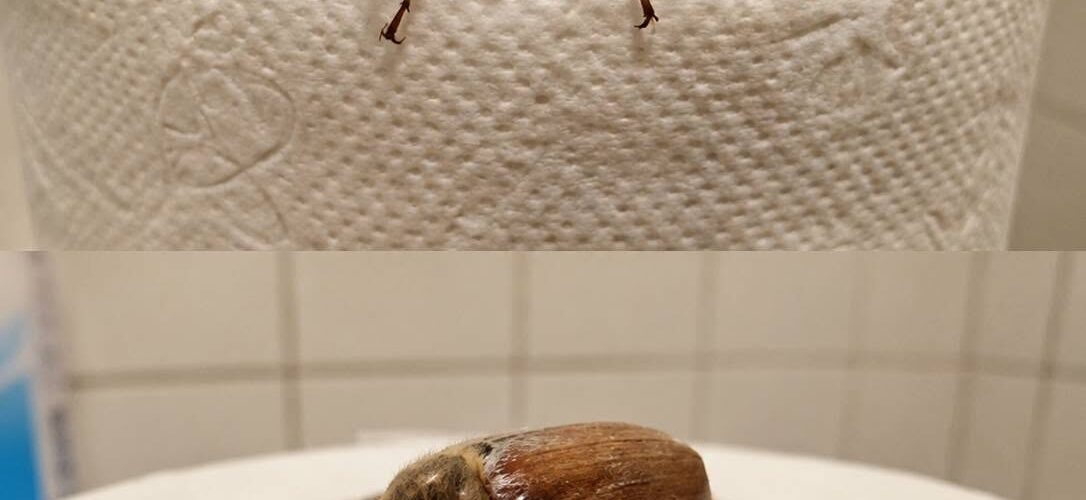
During the warm nights of late spring, it is not uncommon to hear a thud against a lamp or window and discover, when it peeks out, a large, reddish-brown, robust-looking beetle, clinging to some surface as if it had come to stay. That unexpected visitor is usually the so-called San Juan beetle or May bumblebee, scientifically known as Melolontha melolontha.
Although its appearance can be intimidating, it is a harmless insect to people. However, its size, clumsy flight, and habit of being attracted to lights make it one of the most eye-catching late-night guests of the season.
What exactly is the San Juan beetle?
Melolontha melolontha is a beetle belonging to the family Scarabaeidae, the same family that groups the well-known dung beetles. It is native to Europe, where it appears mainly between the months of May and June, hence its popular name of “May bumblebee”. In some Spanish-speaking regions it is also known as the San Juan beetle, because its appearance coincides with the festivities of San Juan.
Its body is between 2 and 3 centimeters long, has a bright reddish-brown color on the elytra (the hardened wings) and a dark, hairy thorax. One of its most curious features is the fan-shaped antennae of the males, which unfold like small combs. These antennae are not merely decorative: they allow them to detect the pheromones of females from considerable distances.
How to identify it: clear signs
If you come across an insect that looks like a beetle and appears in late spring, it is very likely that it is a Melolontha. Here are the main features that help recognize it:
- Considerable size: between 20 and 30 millimeters, which makes it easily visible.
- Bright reddish-brown color on the hard wings, with a darker head and thorax.
- Fan-shaped antennae, especially developed in males.
- Noisy and clumsy flight, with frequent crashes into walls, windows and lamps.
- Sturdy legs with small hooks that allow it to grip tightly on surfaces.
- Nocturnal appearance, attracted by artificial light sources.
Why it enters homes
The sanjuanero is an insect strongly attracted to light. At night, outdoor lamps, illuminated windows, and even cell phone screens can act as a magnet. Their flight, described by many as chaotic, leads them to collide with surfaces repeatedly, since they are not large flyers: they move with energy but little precision.
On the other hand, adults usually feed on leaves of trees such as oaks, beech and other hardwoods, so it is common to find them near wooded areas or gardens with abundant vegetation.
Is it dangerous? Does it sting or bite?
One of the most frequent doubts when this insect appears at home is whether it represents any risk. The answer is reassuring: the San Juan beetle does not bite, does not bite and does not transmit diseases to humans. It’s also not poisonous. At most, it can cling to skin or clothing with its hooked paws, which can cause an uncomfortable feeling but never real damage.
Where it can generate problems is in agriculture and gardening. Their larvae, called white worms, live underground for three or four years and feed on the roots of grasses, cereals and young trees, and can cause significant damage to crops and lawns.
What to do if you find one at home
If the insect entered through a window or landed on a wall, there is no reason to be alarmed or to eliminate it. It is best to help him go outside carefully. Here are some simple steps:
- Turn off the interior lights and open a window or door to the outside. In many cases, the insect will fly on its own into the darkness.
- Use a cup and cardboard: place the cup on top of the beetle, slide a piece of cardboard underneath and move it out.
- Avoid crushing it: in addition to being unnecessary, this insect plays a role in the ecosystem and serves as food for birds, bats and other animals.
- Check mosquito nets and cracks if the situation repeats itself, since in high season several specimens may try to enter attracted by the lights.
How to Prevent Your Entry
If you live near wooded areas and notice that these beetles appear frequently during May and June, you can take some steps to reduce visitation:
- Install mosquito nets on windows and doors.
- Use warm or yellow light bulbs outdoors, which are less attractive to insects than white or ultraviolet lights.
- Keep outdoor lights off when not needed.
- Close the curtains at dusk so that the interior light is not seen from the outside.
A temporary visitor
The good news is that the appearance of the San Juan beetle is seasonal and brief. Adults live only a few weeks, long enough to reproduce before they die. After late spring, their nocturnal visits disappear until the following year. So, if you come across one of these bulky winged hosts, remember that this is a harmless insect, a natural part of the spring cycle, that deserves to be treated with respect and returned to the outside rather than being feared.