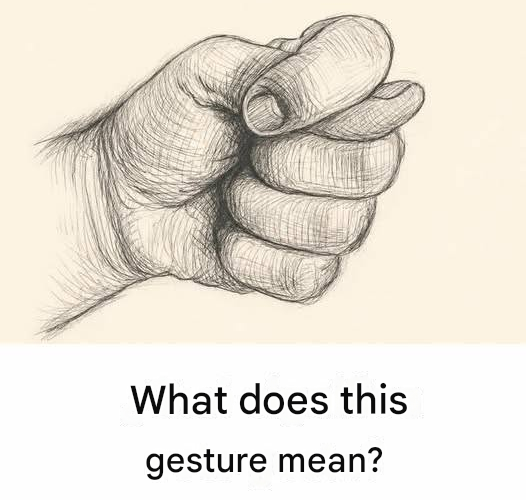
We’ve all seen it before: a clenched fist with the thumb caught between the index finger and middle finger. It seems like a simple, almost childish gesture… But behind it is a story full of symbolism, superstitions, and meanings that have traveled through generations.
Although today many people use it as a joke or even without knowing what it represents, this curious gesture has had different meanings depending on the time and place. For some it was a sign of rejection, for others a protective amulet, and in certain cultures it was even related to good luck.
A discreet but forceful “no”
Many years ago, especially in some regions of Europe, this gesture was used to express a refusal without the need to argue. It was a silent way of saying:
“You’re not going to get what you want.”
The interesting thing is that it was not done aggressively. Rather, it functioned as an ironic or mocking response, used to avoid direct conflicts.
In ancient peoples, some people did it behind a window or hiding their hand to reject uncomfortable requests, annoying comments or unpleasant situations without raising their voices.
It was a kind of secret language between adults.
The famous “fig gesture”
In many Spanish-speaking countries and also in Brazil, Portugal and Italy, this symbol is known as “la higa”.
For centuries it was believed that it served to ward off the evil eye, envy and negative energies. Some people even wore small figures with this shape hanging on necklaces, bracelets or key chains.
The idea behind this tradition was that the gesture acted as a protective barrier against bad intentions.
That is why you can still find amulets today in the shape of a closed hand and the thumb protruding between the fingers.
A symbol with different meanings depending on the country
The most curious thing is that the meaning changes a lot depending on the culture.
In some places:
- It is considered a childish joke.
- In others it can be interpreted as a lack of respect.
- Some people use it to “scare away” bad luck.
- And in certain regions it was formerly used to protect newborn babies.
This shows how such a small gesture can carry centuries of history and tradition.
Why did this gesture survive so many years?
The answer is simple: easy-to-remember symbols are often passed down from generation to generation.
Many grandmothers taught this gesture as protection. Some parents used it to play with their children. And other people just repeated it because they’d seen it all their lives.
Over time, the original meaning began to be lost, but the gesture was still present.
The silent language of the hands
Hands have always been a powerful tool of communication.
Long before texting and social media, people expressed emotions, warnings, and beliefs through simple movements.
A raised finger, an open palm, or a clenched fist could convey entire messages without uttering a single word.
And this gesture is one of the best examples of how something seemingly insignificant can hide a huge cultural history.
Is it still used today?
Yes, although many people no longer know its origin.
In some cases it appears in memes, jokes or viral videos. In others it continues to have a symbolic value related to protection and superstition.
There are even those who still wear “fig” amulets as a symbol of good luck.
Tips and recommendations
- Before using traditional gestures in another country, it is advisable to know their cultural significance, as some can be interpreted differently.
- Ancient symbols often have fascinating stories behind them. Researching their origin can help to better understand the customs of other generations.
- If you find amulets or figures related to this gesture, remember that they are often part of popular traditions and family beliefs passed down for centuries.
- Teaching children about the cultural and historical value of these symbols can be an interesting way to connect with roots and traditions.
Behind this small gesture there is much more than a simple position of the hand. It is a symbol full of history, superstition, protection and silent communication that managed to survive the passage of time and continue to arouse curiosity to this day.