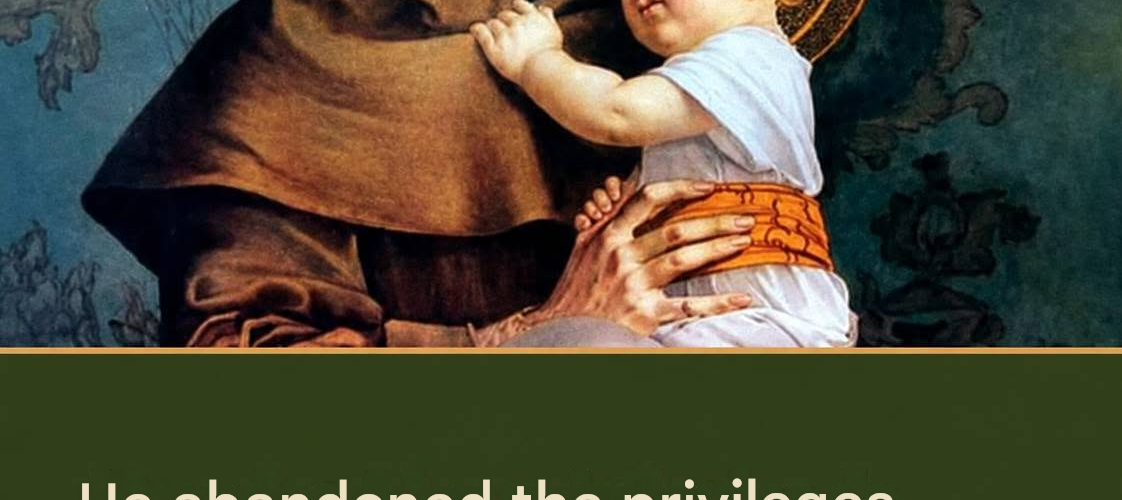
The figure of St. Anthony of Padua, one of the most popular and beloved within Catholicism, contains a story of renunciation, spiritual search and commitment to the most disadvantaged. His life journey took him from the salons of the Portuguese nobility to the Italian squares where he preached against the economic abuses of his time.
A Portuguese nobleman named Ferdinand
Although the data about his early years are shrouded in some uncertainty, tradition places his birth on August 15, 1195 in Lisbon, capital of the then emerging Kingdom of Portugal. Son of Martín de Bouglioni and María Taveira, he received the name of Fernando in the baptismal font.
His family, belonging to the local aristocracy, offered him a horizon of comfort, refined studies and social projection. From a very young age, however, he manifested an inclination that departed from inherited expectations: he wanted to consecrate his life to religious life and the study of the Scriptures.
From the Augustinian cloister to the Franciscan habit
At the age of fifteen he entered the monastery of San Vicente de Fora, belonging to the Augustinian order. The proximity of this place to his family environment was an obstacle to the concentration and seclusion he sought, so he requested to be transferred to the monastery of Santa Cruz, in Coimbra.
There he dedicated eight years to a solid theological formation, mastering the biblical texts, the writings of the Fathers of the Church and the Latin language. His preparation culminated in priestly ordination in 1220, when he was approximately twenty-five years old.
A decisive event changed the course of his life that same year. The community of Coimbra received the remains of five Franciscan friars who had been executed in Morocco while trying to evangelize the region. The extreme testimony of those men deeply moved Ferdinand, who decided to abandon the intellectual stability of the Augustinian monastery to embrace the radical poverty preached by Francis of Assisi.
When he adopted the Franciscan sackcloth, he changed his name to Antonio, in honor of the famous anchorite of the Egyptian desert. This gesture symbolized a total break with their previous identity.
The failed trip to Morocco and the meeting with Francis of Assisi
Moved by the desire for martyrdom and evangelization, Anthony left for North Africa. However, shortly after arriving he contracted malaria, which prevented him from continuing his mission. During the return journey, a strong storm diverted the boat to the coast of Sicily, where it was welcomed by a local Franciscan community.
In the spring of 1221 he travelled to Umbria to participate in the well-known “Chapter of the Mats”, a multitudinous assembly of the Franciscan order in which he had the opportunity to meet its founder personally. After the meeting, he was sent to the province of Romagna, where he settled in the secluded hermitage of Montepaolo, taking care of humble tasks and deliberately concealing his academic training and aristocratic origin.
The Preacher Revealed in Forlì
Antony’s anonymity ended in 1222, during an ordination ceremony held in the city of Forlì. Due to organizational confusion, no speaker was prepared to address the attendees, and the superiors asked Antonio to improvise a homily. His words left those present amazed by the clarity of his exposition, his biblical knowledge and the theological depth of his speech.
From that moment on, the order appointed him official preacher, entrusting him with missions in different cities in Italy and the south of France. His eloquence became a powerful tool to combat heresies and revive popular faith.
The defense of the poor against usurers
One of the most remembered aspects of his ministry was his firm denunciation of usury, a widespread practice in Italian cities in the thirteenth century that plunged peasants and artisans into unpayable debts. Antonio publicly confronted unscrupulous lenders and merchants, demanding that they return what was collected in an abusive manner.
His action was not limited to preaching: he promoted municipal laws that protected insolvent debtors from prison, especially in the city of Padua. Among his social contributions are:
- The promotion of rules that prevented the imprisonment of people who could not pay their debts.
- Mediation between creditors and debtors to reach fair agreements.
- Open criticism of the economic abuses of the powerful and merchants.
- Public advocacy for widows, orphans, and exploited workers.
Legacy and veneration
Antony finally settled in Padua, a city with which his name would be forever linked. He died on June 13, 1231, at the age of thirty-six, exhausted by preaching and penances. Just a year later, in 1232, Pope Gregory IX canonized him, in one of the most rapid processes in the history of the Church.
In 1946, Pope Pius XII proclaimed him a Doctor of the Church, recognizing the value of his theological writings. Today he is popularly invoked as the patron saint of lost objects, the poor and the oppressed, and his feast day is celebrated every June 13 in many countries around the world.