Fundamentals of Japanese sharpening
Knife sharpening in Japanese culture is a practice that combines traditional craftsmanship and modern efficiency principles. The technique demonstrated in the video emphasizes the following aspects:
- Proper Preparation of the Environment: It is recommended to work in a clean and stable space, with well-maintained tools.
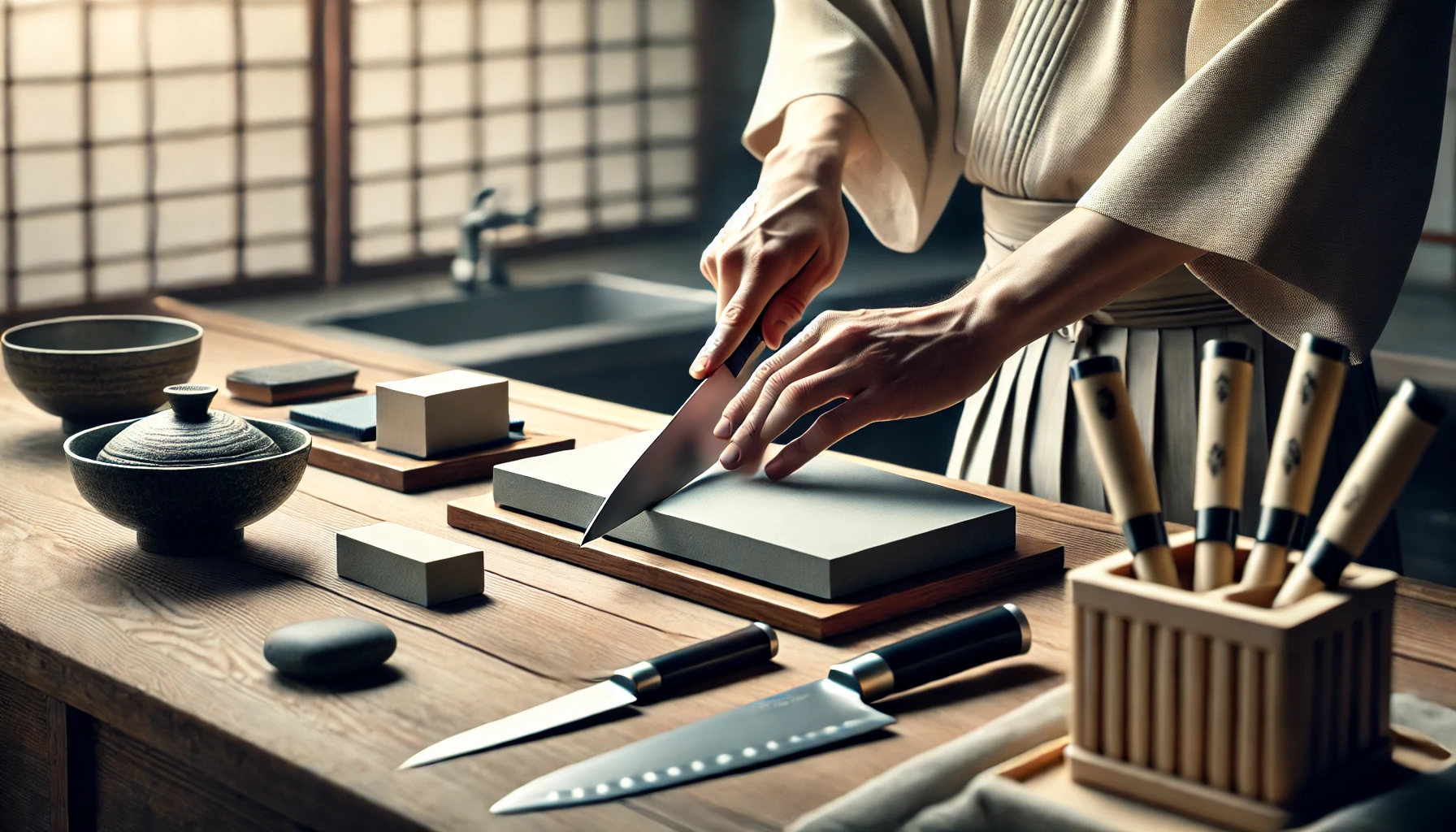
- Use of whetstones: Instead of automatic sharpeners or the use of other abrasive materials, Japanese sharpening stones (such as those with a grain of 1000, 3000 or higher) are used, which allow for progressive and controlled sharpening.
- Constant Angle: The secret to good sharpening is to maintain the same angle between the knife blade and the stone (usually 15-20 degrees) throughout the process.
- Respect for steel: Japanese steel is known for its hardness and quality; sharpening it correctly helps to preserve its properties.
Key steps to sharpen in less than a minute
- Soaking the stone: Before you begin, the stone should be soaked for several minutes so that it is fully saturated. This allows for smoother and more effective friction.
- Firm positioning: The knife should be held firmly, with your fingers guiding the movement over the stone for better control.
- Smooth Motion: The knife should be slid into the stone with long, steady and oblique movements, covering the entire length of the blade.
- Alternation of sides: It is crucial to alternate sharpening of both sides of the blade to maintain symmetry and avoid imbalance.
- Edge Check: After a few passes, the edge is checked to see if it has improved, using, for example, a sheet of paper, tomato or even the hair on the arm.
- Repetition if necessary: Depending on the condition of the blade, the process can be repeated several times to achieve the desired edge.
Tips to improve technique
- Practice consistency: The biggest mistake when sharpening is varying the angle. Practice with slow movements before attempting speed.
- Don’t use too much force: The process should be smooth. Applying excessive pressure unnecessarily wears down the blade and stone.
- Keep the stones level: Use a flattener to make sure the surface of the stone is even, which improves the quality of the sharpening.
- Periodic maintenance: Sharpening regularly prevents the knife from wearing out too much and makes it easier to maintain the edge.
- Cleaning tools: After each sharpening session, clean the stones and knives well to prolong their life.
Final recommendations
- Invest in quality tools: A good whetstone is a smart investment for any kitchen. Natural Japanese stones, although expensive, offer exceptional results.
- Learn from the experts: Watching videos like this allows you to acquire better habits and discover techniques that are often overlooked. You can also consider taking in-person or virtual courses.
- Be patient: Although the goal is to sharpen in one minute, quality should be above speed, especially when starting out.
- Use markers to train the angle: A common technique is to color the edge with a black marker to see if you’re sharpening correctly.
Conclusion
This Japanese approach to sharpening knives reflects not only efficiency but also respect for the culinary art. Learning this technique not only enhances the cooking experience, but also connects with a centuries-old tradition of precision, care, and excellence. Mastering it can transform your relationship with cookware and give you a sense of self-sufficiency and control over the quality of your tools.