

Temporal tapping is an ancient technique rediscovered.
It was first used in the East as a painkiller, but it turned out to be very effective in breaking old habits and creating new ones at the same time.
Tapping along the temporal bone, starting from the temples and in a circle to the back of the ear, makes the brain more receptive and temporarily suppresses other sensory impulses.
It also calms the triple energizer, because tapping occurs in the opposite direction to its natural flow, and in fact, this meridian most decisively manages the habits in the body.
By calming the part of the nervous system that is struggling to maintain old habits, you can form a new habit much easier.
In the 1970s, the founder of applied kinesiology, George Goodhart, discovered that tapping the cranial line between the temporal and sphenoidal bones temporarily removed the mechanisms that allow sensory impulses to pass through.
If you apply autosuggestion or affirm something out loud while tapping, the brain will be extremely susceptible.
Tapping on the temporal bone also captures the differences between the left and right hemispheres of the cerebral cortex.
Because most people in the left hemisphere are encoded with criticism and skepticism, negative statements are more closely related to how it functions, and they are more likely to accept them.
For such statements, we tap the left side of the head. Similarly, since the right hemisphere perceives positive information, for a positive formulation of statements, we tap the right side.
This pattern works the opposite for some left-handed people, but you can test energetically to be sure.
If you have a good result when patting the left side, accompanied by a negatively worded statement, follow the instructions; Otherwise, change the places to “left” and “right” in the instructions.
Start by identifying a habit, attitude, automatic emotional response, or health-related condition that you want to change.
Describe the desired change in 1 sentence, stated as a positive statement in the present tense, as if the desired state is already present.
This may not be true at the moment, but it expresses your desire for it to be true in the future.
For example, you could say, “When I’m under pressure, I stay calm.”
It’s also a good idea to write down your statement. Then repeat the statement, keeping the same meaning, but phrasing it with negative particles (e.g. “no,” “never,” “none,” etc.).
Thus, “calm and balanced” will transform into “When I am under pressure, I no longer get stressed.”
Note that the meaning remains positive, even though the statement is worded negatively. Another example: “I eat for health and well-being and enjoy food” can be transformed into “I don’t eat because of anxiety and compulsion.” “My nails are growing long and healthy” becomes “I no longer bite my nails.”
1. Starting at the temple, tap the left side of the head from front to back with the three middle fingers (index, middle, ring) of your left hand. Say the negatively worded version of the statement, keeping the rhythm of the taps. Tap hard enough to make firm contact and feel a slight push. Tap from front to back about 5 times, saying the statement each time.
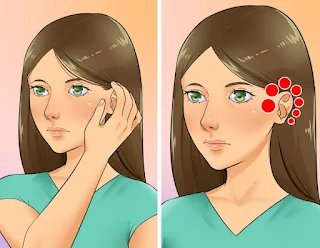

2. Repeat the technique on the right, tapping with your right hand and this time using the positive form of the statement.
3. Repeat the procedure several times a day. The more you tap and affirm the new pattern, the stronger the effect on your nervous system and habit field.
Temporal bone tapping is a combination of many powerful elements, including repetition, autosuggestion, and neuronal reprogramming.
It affects not only the brain, but also every meridian, so the message of your intentions is sent to every system in the body.
This is a temptingly easy method for changing many energy patterns that cannot be overcome through willpower alone.
The parallels between our physical and emotional problems are amazing. Sometimes the behavior of an organ begins to reflect the way we behave. I will use myself as an example.
Sometimes it is difficult for me to set clear boundaries between me and people. Given the nature of my work, this can be an insurmountable problem. Years ago, I became extremely susceptible to infections.
It was as if my thymus gland, responsible for protecting the body from infections, was modeling its behavior analogous to mine.
I began tapping on my left temple with the words: “My thymus gland no longer allows foreign invaders to penetrate my body,” and on the right: “My thymus gland vigilantly observes strict boundaries that keep foreign invaders at bay.”
Not only has my resistance to infections improved, but so has my ability to create boundaries between myself and others.
Part of the charm of this method is that by stating your intentions in two short sentences, you sometimes get to the deep end of a complex and surprising relationship between body, mind, and soul.
There is another application of temporal programming points – silently stroking them instead of tapping. It is both soothing and comforting.
When you want to satisfy a strong desire, stroke the temporal points on both sides of the head at the same time and breathe deeply. For example, if you feel a frantic hunger or a desire to give in to another addiction, stroke the temporal points. Many people calm their passions this way and the feeling of panic goes away.
I am so convinced that temporal programming is the best means of regulating our lives that I would like to tell you a few cases where it did not work, as they are instructive about how to put it to work, i.e. what mistakes not to make.
I have noticed that temporal programming does not work if the statements are not verbally constructed precisely. The words must be in a language that is well known to you.
Sometimes it is preferable for sentences to be stated simply, in the most accessible language possible, rather than moralistic, religious, New Age, or other “maniacal” words that are far from our way of thinking.
It is also important that the words are connected to our values and correspond to feelings so that when we say something, it doesn’t come across as if we are thinking about something else or trying to dismiss a basic need.
A woman wanted to lose 9 kg, but instead gained 15 using this method. On the left side, she patted herself with the statement: “I am no longer holding on to my excess weight,” and on the right: “The arrow on my scale points to 75.” The sentences seem correct, but the effect was the opposite.
I asked her to notice if her thoughts followed the words, if her mind wavered or other images entered it. It turned out that with each pat, she thought: “Damn, I look like an aunt, I’ll end up looking like my (fat) Aunt Sophie.” She patted herself with this thought 5 times a day. And it worked!
The thought and the image were a much more powerful suggestion than her carefully chosen statements. In fact, the woman lost a lot of weight when she changed the sentences: on the left with “I did not inherit Aunt Sophie’s body” and on the right with “I inherited a body that can be fine and flexible.”
My friend decided to quit smoking after struggling with a chronic cough for over a year. I taught her temporal programming. By tapping herself with the statements “I don’t smoke anymore” – on the left, and “I like life without cigarettes” – on the right, she started smoking like crazy and looked very unhappy.
Something strengthened her habit, and this frightened her very much. Despite the fact that programming definitely had an effect, albeit the opposite of what she wanted, she realized that the technique worked and decided to try to use it to her advantage.
She felt that anxiety was the key to the problem. The statement “I don’t smoke anymore” provoked her anxiety, in part because smoking was her main method of relaxation.
Turning on her intuition, she discovered a new verbal formula. On the left, she began tapping with the words: “Anxiety no longer makes me smoke,” and on the right: “I now smoke only for pleasure and to be healthy.” Her anxiety decreased sharply, and from a pack of cigarettes a day, she went down to 3 cigarettes a week.
He held this position for months, using the occasional cigarette as a mantra and an act of meditation. Her cough disappeared. In the end, she completely gave up smoking.
As with energy testing, and with most things in the book, the techniques often require more than a mechanical tap.
I have observed the successful impact of temporal programming on a wide range of problems. It helps people stop smoking, drinking, overeating.
It helps to build self-confidence, optimism, self-esteem. It makes the immune system resistant to various diseases, improves metabolism when trying to lose weight, strengthens coordination when building new skills.
Choose a behavior, emotion or physiological state that is your goal. Formulate a negative statement about the left side, and a positive one about the right.
Tap 5-6-7 times a day for at least a week. With deep-rooted habits, it takes at least a month before the results become apparent. Even if you are skeptical, judge for yourself based on the result obtained.
(1) The statement about the left side contains at least 1 negative particle, and the statement about the right side – only positive ones.
(2) Statements are harmonious with the way you usually think, feel, and express yourself.
(3) By saying the statements, you keep your attention on the words and their meaning.
(4) Statements do not make you do things that contradict your value system or your basic needs.
It will be great if you follow us and share this article with your friends and your opinion (or experience) in the comments!