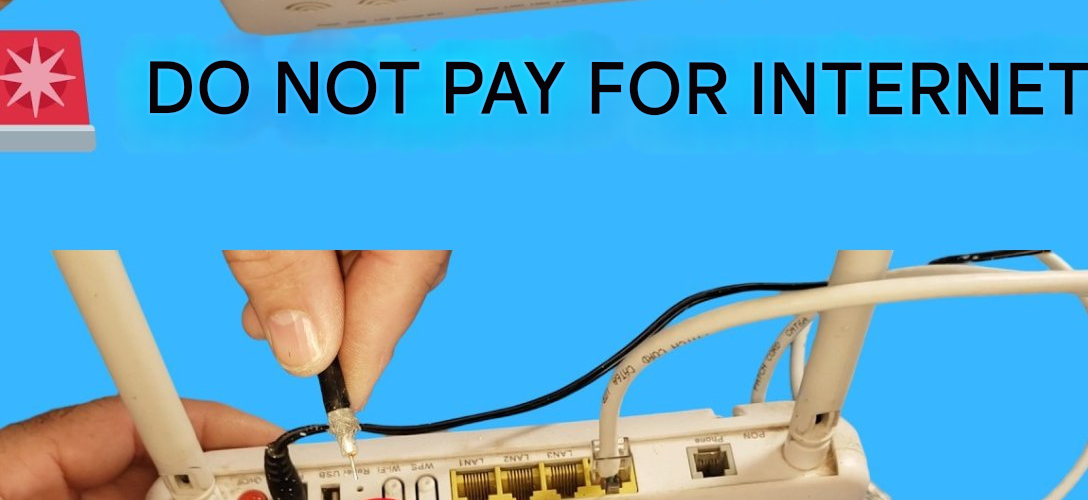
Today, many households rely on the internet to access television content, which means a constant monthly expense. However, there is an inexpensive and accessible alternative: building a home antenna to receive open digital television signals.
In this article, you’ll learn how to make a functional HD antenna from recycled and common materials, without the need to buy expensive devices.
Materials Needed
- Coaxial cable (at least 2 meters)
- Blade or cutter
- Ruler or tape measure
- Coaxial connector
- Adhesive tape or wire for attachment
- Lightweight plastic item (such as a cotton swab or tube)
- Optional: Soldering iron
Step by step to build the antenna
- Cable preparation:
- Cut approximately 90 cm of coaxial cable.
- Carefully remove the outer sheath, mesh, and dielectric until the inner conductor is exposed.
- Dipole formation:
- At 13.5 cm from the end, bend the cable.
- From that point, measure and fold back to 7 cm.
- Repeat the sequence to form an equilateral triangle.
- Repeat the process:
- Make another identical dipole using another 90 cm length of cable.
- Joining the dipoles:
- Line up the two dipoles so that they are at the same distance and joined at the contact end.
- Use wire or tape to secure them. Optionally, solder the joint points for firmness.
- Structural reinforcement:
- Use a plastic item (such as a cotton swab) between the dipoles to prevent them from moving and maintaining their shape.
- Connecting to the TV:
- Place the coaxial connector on the free end of the cable and connect it to your TV’s antenna input.
- Places the antenna in an elevated position and oriented towards the signal source.
- Tuning:
- From the TV menu, select “Antenna” as the input source.
- Run an automatic channel search.
Additional tips:
- Accurate measurements: Use a ruler to respect the dimensions, especially the 13.5 cm and 7 cm formed by the dipoles.
- Antenna Location: Place the antenna near a window or at a high point to improve reception.
- Avoid interference: Move the antenna away from electronic devices that can generate signal noise.
- Orientation tests: Rotate the antenna slowly and repeat tuning if you don’t pick up as many channels as possible.
- Use without impedance transformer: Thanks to the geometric design, this antenna is calibrated to achieve 75 ohms of impedance without the need for a balun.
By carefully following the instructions and measurements, it is possible to achieve reception of comparable quality with commercial antennas. This solution is ideal for those who want to reduce expenses or do not have access to the internet.
Go ahead and build yours and discover everything you can watch for free!