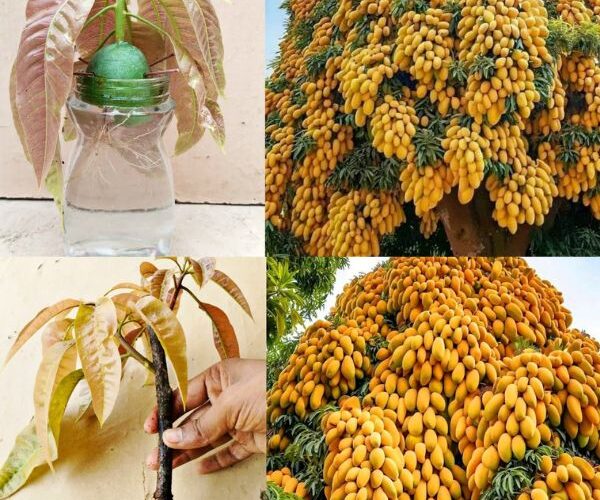

An exotic plant native to India, the mango adapts well to all hot latitudes and can also be grown in pots, from its seed. Planting the mango seed in a pot is a very simple operation that allows you to enjoy the beauty of this particular tropical plant, making it the queen of the balcony of the house.
Mango is easy to plant and grow, but if you want it to bear fruit, you need to equip yourself with patience and space. The mango, in fact, in nature, grows quickly until it becomes a tree even 25 meters high that manages to produce a quantity of thirst-quenching and vitamin-rich fruits, which in captivity is only possible under certain conditions: space and grafting.
Index
- When to plant mango seeds
- Mango tree planting: germination
- How to Plant Mango Seeds
- How to Grow a Mango Plant
- When does mango bear fruit
When to plant mango seeds
The most suitable seasons for planting mangoes are late spring or, better yet, early summer. This is because this time of year is characterized by mild temperatures and longer days that will allow the seedling to benefit from a greater number of hours of solar radiation.
The mango, on the other hand, is a plant that does not tolerate temperature changes and for this reason mild temperatures are ideal for sowing, for growth but also to keep it alive. In order to preserve the plant from thermal excursions during the colder months, it is advisable to use the same precautions used to protect lemon trees (i.e. plastic or fabric covers) or to transfer the plant inside the house (provided that it is in an area where it can be illuminated for several hours by direct light).
Mango tree planting: germination
Germinating the mango tree seed before planting it sufficiently strengthens the young roots which will have a better chance of taking root and growing our seedling.
The best way to germinate mangoes is to use a plastic bag or food container as an “incubator.” In order to germinate mango, three basic steps must be followed
- The mango seed must first be extracted from the shell. This is a delicate operation during which care must be taken to clean the seed extracted from the coat, but above all not to damage it.
- In a second step, it is necessary to create the artificial housing for the seed. To do this, it is necessary to wet a sheet of paper towels and place the mango seed inside without smothering or tightening it too tightly. At this point, everything must be placed in the food container, or in the transparent plastic bag: everything is allowed, as long as it can be closed to keep the humidity high.
- Taking care of the sprouted mango seed is very important. The sheets of paper in which it was wrapped should be replaced at least once a week and should always remain moist (for this purpose we can use a plant sprayer). It takes a few days for the mango seed to take root and about two weeks for it to start germinating. When the shoot is about 4 centimeters high, it is ready to be planted in the ground.
How to Plant Mango Seeds
When the root is strong and the growth is vigorous, the time has come to plant the mango tree seed and the ideal place is a pot that is not too large about 10 cm in diameter that is enough to accommodate the seedling and grow it in the first phase of its life, and then transfer it to a larger vessel.
As a potting soil, it is advisable to use universal soil, easily available in supermarkets and garden centres, to be enriched with homemade compost. The seed should be planted in cuttings, i.e. with the root facing down and the shoot upwards. If the root is made up of seeds wrapped near the shoot, there is no need to worry: when the mango seed is in the vase, the root will descend naturally. It is important to remember that the shoot must remain above ground.
How to Grow a Mango Plant
The mango tree needs a lot of water, especially during the growth phase. It is therefore necessary to make sure to water it regularly to prevent the soil from drying out completely but without creating stagnations that could cause it to suffer.
When the mango tree has strengthened, the stem should be cut back at the height of the first node. This operation will strengthen it and give impetus to its growth. In addition, the plant should be placed in a well-lit location but without excessive direct sunlight, especially during the hottest hours of scorching summer days.
It is possible to check the health of the leaves, which should be bright and long and stretched in colour. The mango tree grows quickly, but a healthy and robust plant is not enough to obtain fruit.
To make the mango plant fruitful, a graft is necessary and it is therefore advisable to contact a specialized nursery, alternatively it is possible to choose the seed of a local mango variety such as those grown organically in the south of Italy and especially in Sicily.
When does mango bear fruit
The mango tree is a very special plant and it takes years to fruit, given that a mango tree born from a seed can take up to eight years to fruit (but it can also fail if not grafted); while grafts produce the fruits after 3-5 years and guarantee a good harvest.
Generally, the mango at the age of three or four years produces 10 to 20 fruits per tree, increasing to 50 to 75 fruits in the following years, and about 500 fruits in its tenth year of life. Obviously, from year to year, the plant grows and this will have to be transferred to larger and larger pots or to soils capable of spreading its roots.
Having a mango tree that bears fruit is a real privilege because this fruit is a real elixir of well-being that can be enjoyed in different ways. In particular, mangoes are a good source of vitamin C, vitamins, minerals, and dietary fiber that help fight sluggish gut.
In addition, among its properties it is worth including the anti-inflammatory and antimicrobial properties due to the presence of flavonoids, such as quercetin.