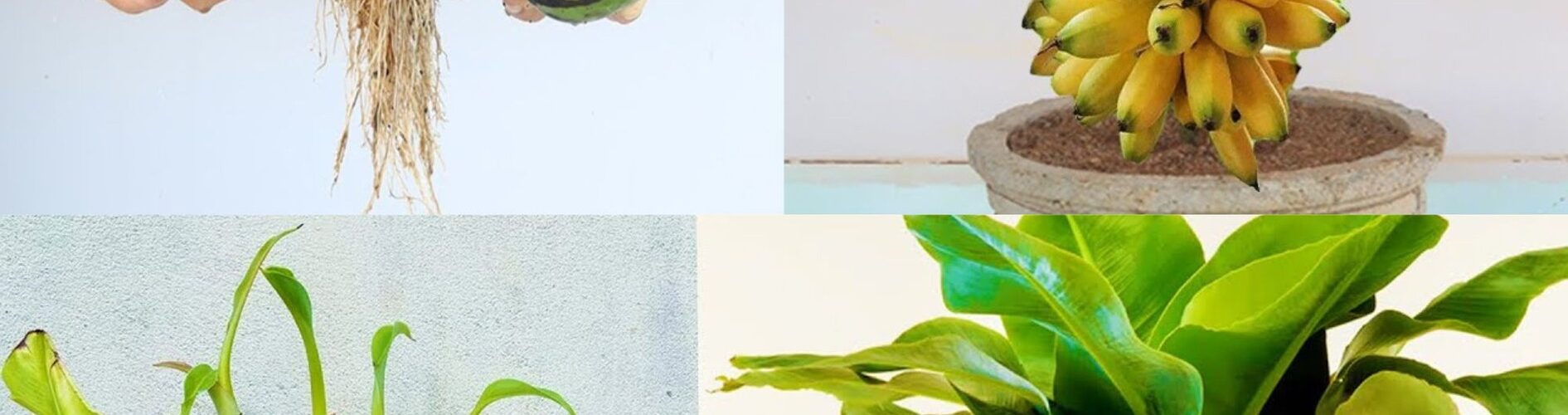

Growing bananas in pots is very easy and accessible to everyone. And the result is spectacular, because even if we don’t have big harvests, we will have a decorative shrub with large leaves that spreads tropical air everywhere. Learn how to plant and care for them in this step-by-step article.

It doesn’t matter if you live in a tropical climate, you can grow and care for your bananas in pots yourself. If you start growing the normal variety, the banana plant can reach a height of 10 to 15 meters, but if you have a dwarf banana, it will not reach more than 3 meters in height.
Banana varieties to grow in pots.
These dwarf banana species are only 1.5 m to 3 m long. (4 to 12 feet) tall and suitable for growing in containers. You can also grow these varieties of bananas indoors.
- Red Dwarf
- Miniature Cavendish
- Brazilian dwarf
- Jamaican dwarf
- Rajapuri
- Williams Hybrid
- Great Dwarf
- Dwarf “Lady Finger”
If you want to grow ornamental bananas, check out these varieties:
- ensète ventrikosum
- Musa sikkimensis “red tiger”
- Ornate Muse
Soil requirements for growing bananas in pots.

- Banana plants need sandy, well-drained, highly fertile soil rich in organic matter.
- Enrich the soil with organic or natural compost.
- It is recommended to use good quality commercial pots instead of garden pots.
- But don’t buy normal heavy pots, instead choose flower pots for cacti or palm trees, which is a great choice for containerized bananas.
- To make homemade potting soil, mix equal amounts of sand, perlite, or vermiculite, and compost or manure.
- The pH of the soil should be between 6.0 and 7.0. To balance the pH, use sulfur to lower the pH.
- The banana tree prefers slightly sour to neutral to produce flavorful bananas.
Climate conducive to growing bananas in pots.

- Banana plants typically need warm subtropical or tropical climates to thrive. Banana plants can tolerate extreme heat with a good amount of water.
- Bananas can withstand the cold for a short time, but when the temperature drops below 14°C, the tree stops growing.
- In cool regions, as temperatures drop, the leaves turn yellow and the skin of the fruit turns gray.
- The banana plant in the containers can die at any time, in winter it is best to take the containers home.
- The ideal temperatures for growing bananas in pots are 26°C to 30°C.
Humidity for potted bananas.
The banana tree prefers a humidity of more than 50%. To keep moisture all around the plant, mist the plant and place it in a container filled with water on a layer of pebbles.
The right pot size.

- Bananas need a wide, deep container to grow.
- Choose a medium-sized container with a hole for growing bananas in containers.
- The ideal container size for bananas is 6 to 8 inches deep and 5 inches wide.
- Remember that the depth that is going to be done plays a crucial role, because the roots of the banana need a good place to grow.
- The container can be ceramic, plastic, metal or a wooden pot. The use of clay pots is highly recommended.
- Bananas can be transplanted after 1 to 3 years.
Irrigation.
- Bananas like humidity. Water regularly and deeply, but be careful not to overwater.
- Water every day in summer. In hot weather or with a root attachment, it may even need to be watered twice a day. The land for growing banana trees must be kept uniformly moist. Reduce watering in winter.
Fertilizer.
- Use fertilizers rich in magnesium, potassium, and nitrogen.
- Use a water-soluble fertilizer or sprinkle granular fertilizer on the soil without touching the main stem.
- Fertilize the young plant, if it is well established, with a nitrogen-rich fertilizer to help it grow faster.
- Once your potted banana plant is mature enough to produce fruit, fertilize it regularly with NPK fertilizer:.
Plagues and diseases.
- Bananas are quite resistant to disease, even if the leaves turn brown and dry out around the edges, all of this means that you are watering too much and if the leaves turn yellow, the banana plant lacks nutrients.
- Some pests that could infect banana areaphids, banana weevils, and coconut mealybug. These pests can be easily repelled with organic pesticides.
Thank you for reading this article, we are sure that from now on you will be able to grow the banana tree you have been dreaming of having at home.